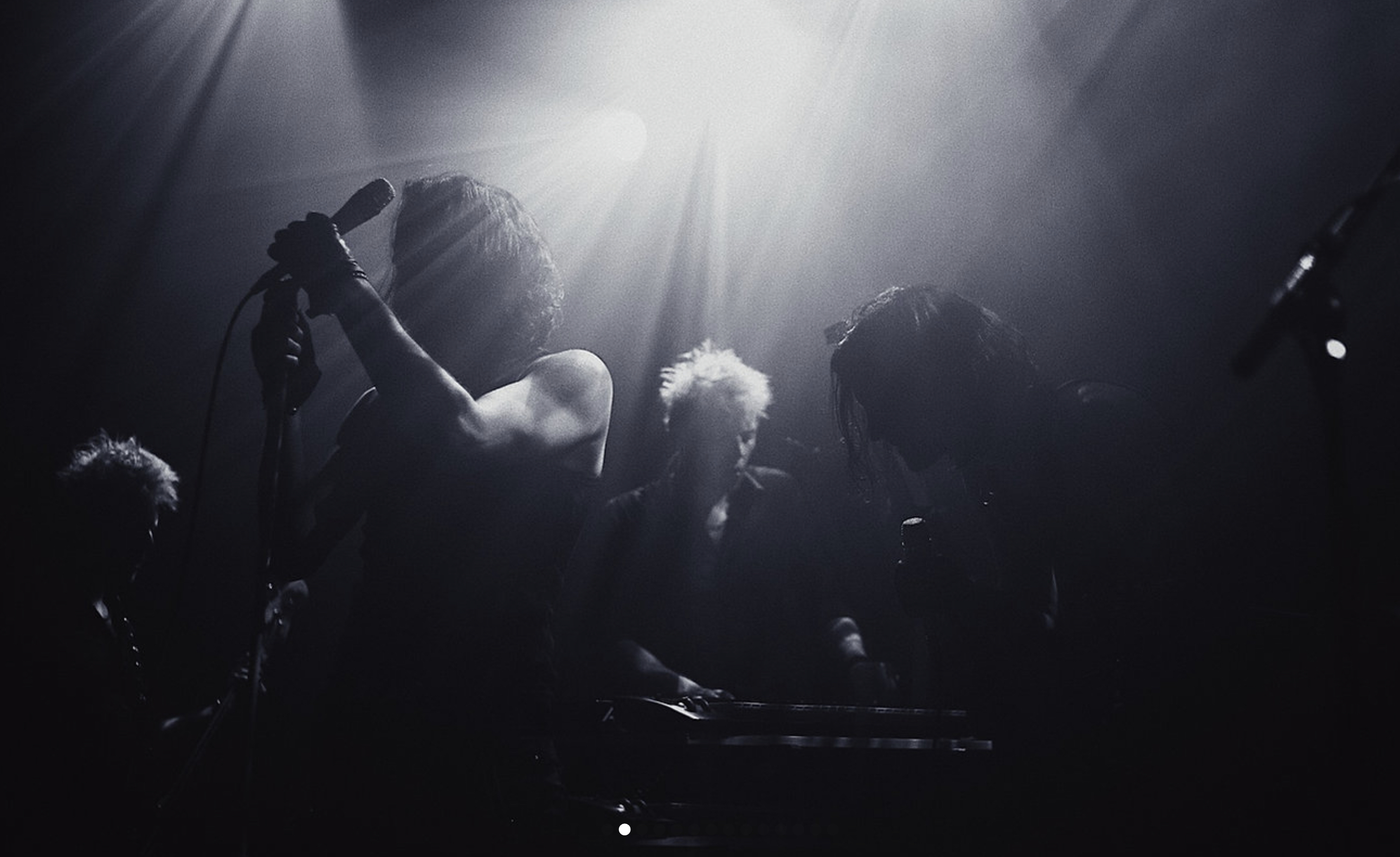
The new single Repetition by UK Post Punk/ Synth duo Peak Flow is a brooding collision of post punk tension and synth lit melancholy. It plays like the soundtrack to a relationship on repeat. Bright synths offer brief moments of clarity before the guitars swallow them in static. The melody seems to keep reaching upward even as something darker coils beneath, mirroring a relationship stuck in the same snake like looping argument.
The synths try to soothe, but the undertow of noise keeps dragging everything back into the conflict. Grinding textures meet razor like synth lines, creating a tension that never quite resolves. It’s the sonic equivalent of two voices locked in the same old clash, with equal parts of desire and frustration. Repetition seems to stalk forward on industrial grit and nostalgic neon hued hooks. It ultimately sounds like two people beautifully and abrasively circling the same emotional drain.
“The track is remembering the sudden passing of a close friend and the feeling of total loss, guilt and helplessness”
Peak Flow
A haunting new anthem of loss by UK Post-Punk Goth duo Peak Flow delivers raw emotion through synth- driven darkness. Don’t Die In Your Sleep, the latest offering from Peak Flow stands as both a sonic triumph and paradoxically the exploration of an emotional devastation. The track serves as a memorial to sudden loss, channeling grief through the band's signature blend of 80s nostalgia and contemporary darkness.
The foundation of Don’t Die In Your Sleep is built on punchy, synth-driven hooks that immediately recall the neon-soaked atmosphere of the 80s alternative scene. The synthesised melodies cut through the mix creating an almost hypnotic pulse that draws listeners into the emotional undertow, mirroring the internal turmoil of grief. These moments of sonic friction serve as perfect metaphors for how loss disrupts the rhythm of daily life.
The dark vocals float above this instrumental tension delivering lyrics with a vulnerability that feels both intimate and universal. What elevates this track beyond mere emotional catharsis is its unflinching examination of survivor's guilt and helplessness. By grounding their sound in 80s aesthetics while addressing contemporary themes of loss the duo creates a bridge between eras. This isn't nostaglia for nostalgia's sake, but rather a recognition that certain emotional truths are timeless, even as the sonic palette evolves. Peak Flow has crafted something that honors both their departed friend and the ongoing struggle of those left behind. It's a song that demands to be felt rather than simply heard, and in that demand lies its greatest strength.
Andrew Jones of Berkley’s early interest in music led him to understand that songwriting was a viable way to express his feelings. He explains “When I was really young, I would hear music that made me feel things I didn’t understand, but I loved that experience. I didn’t comprehend at the time that I was learning about life through the radio.” Strengthening his sense that music was a more complete way to express himself was Andrew’s exposure to Punk during his adolescence. Andrew says, “that led me to learning how to play guitar and other instruments, bands, basically the rest of my life.”
Feeling obliged to the Punk ethos, Andrew cites Descendents as a huge influence on him and what he describes as the “DIY aspect of getting something off the ground.”Andrew discusses a formative time in every musician's life when what they are listening to just becomes embedded within their musical experience. He admits “I probably am unaware of where Weezer lands in my thinking, but I was obsessed with them when I was 15 and 16 so they’ve got to be in there somewhere.” Other musical influences for Andrew include a time he recalls as “this year when a bunch of singer-songwriters entered my world at the same time, and it was stuff like Pete Yorn, Rufus Wainwright, Aimee Mann, Elliott Smith, a lot of west coast singer-songwriters or people on Dreamworks. Pete Yorn and Aimee Mann were big ones because I had been listening to all this music with singing that I was just never going to be able to comfortably mimic or naturally sound like.” Andrewadmits that when he heard Pete Yorn and Aimee Mann, he heard people that had a vocal timbre like his own. He also says, “Rufus Wainwright was a similar experience, but his music opened me up to a new world of influence that still fascinates me.”
When explaining what drew him as a performer to his particular genre Andrew details that “Learning how to play guitar sort of drives you into this area of music that’s on a spectrum of attitude, and it’s all pretty masculine. Guitar music starts aggressive when you’re young and then gets mellower as you get older, indie, I guess is what it is, but it’s still typically a guy with a guitar. You can see this in all the alt country bands that have members of punk bands from the 90s, or how some punk guys have solo projects that are them and an acoustic guitar. I really resisted that for a long time, but I had to accept this was where my roots are. I feel that you have to make something to evolve and that’s what this album now feels like creatively, like a way forward toward new ways of making music.”
Having been in several bands and after performing a lot around Pueblo, Colorado, where Andrew grew up, he went on to touring throughout the state. Following the touring he co-founded a band in Los Angeles which would be the last band he would belong to. Taking a break after the band dissolved Andrew found “All that writing and performing developed these agile songwriting muscles that got soft during that time off, so I had to spend a lot of time rediscovering my passion and purpose for writing to get to a point where I was satisfied with what I was making. That was all on my own and developed naturally into a solo career. But there’s a lot of collaboration that goes into that as I make records.”
Andrew says although he is still trying to figure out a “sustainable approach” to songwriting, he likes to draw on nostalgia and memory. He explains in regard to his latest album “this album came from examining the feelings I had when I was younger with the perspective of someone older, so it all had this coming-of-age feel to it. I’ve said all I need to say in that respect with these songs, so I want to do something different for the next album, and my early writing for that still has some pangs of nostalgia or looking back and seeing things a little clearer. I think I’m finding out that I’m always going to be writing about the continuum of time and memory. We seem to try to segment time and mark its passing with rites of passage. But something this album taught me is that you can feel like something that happened 20 or 30 years ago happened yesterday. Where it gets interesting is when you try to recall the details. You might be able to embody a feeling exactly but what led to it gets cloudy as soon as it happens. All this stuff that’s just below the surface can be so old. There’s a lot to explore there for songwriters!”
When it comes to the aesthetic for Berkley,Andrew likes to collaborate with other creative people, giving them a seed or a full vision of what he would like. He does however explain that “there are other things that sometimes time necessitates I do myself, like a lot of the videos for the singles from Pueblo. I’m always involved to some degree, though, and establish the direction and know when we’ve reached the end.”
In order to stay creatively inspired and continue to grow musically Andrew says “Before Berkley I was engineering and producing in north Texas for a while, and that kept me inspired. Working with or for other musicians will really keep you sharp. In that time, I also fell in love with electronic music, especially the pioneers like Mort Garson, Suzanne Ciani, YMO, Tomita: the greats. That’s just an extension of what I love about recording music. All the dials and switches and stuff, harnessing voltage and translating that into something you can hear. That will never not be interesting to me. Moving to Portland, Oregon has been great for my songwriting. There are so many active, good songwriters who are really open to talking shop and playing together. Getting involved with some songwriters here instantly pushed me forward in my writing.”
Although he felt he had to train himself to get excited about performing live again Andrew admits he does enjoy it. He reiterates that “Sometimes it feels like work, like this is something I have to do if I want this other thing, like to make the money back on records I made or whatever, but once the set has started and you’re talking with the audience and they’re reacting and it’s all interactive — when you’re in the flow of it — it’s exciting. I know I’m still into it because when I get home from the gig I need to come down before I can even think of going to bed.”
Andrew believes that he could connect better with fans but it's not something that he enjoys, he explains “It’s not making music most of the time, all the posting and making little videos that take 10 times the amount of time to produce than it does to consume…I’d rather just play live more often. I could spend less time on my craft and fight with an algorithm that does not have my best interests in mind, or I could play live and get the same amount of followers at the same rate. When I’m there with people in the same room, I can be real with them, and we can have an exchange. You learn something about me, and I invite you to share what you want with me. Online, it’s so one way. I’m not really at a level where that’s appealing to a lot of people, and if I were at that point where people couldn’t wait for my next post, I would really have to consider what I was contributing: music or social media content?”
In terms of where Andrew sees Berkley heading in the future he says “We haven’t started the tour yet but I’m already in this mode of thinking that the album is very much done, I’m just reproducing that for people now, so what am I doing for me? I keep refining my songwriting, so that will always be in development, but how I deliver that on a record is something I’ve been thinking about a lot lately. I want it to sound different than Pueblo, less obvious in where the music is coming from. This is a pretty traditional album: guitars, bass, drums, keyboards. I want to push myself to make different sounds in the context of some things that “feel Berkley” as my next frontier. I think everything you do is contributing to a larger goal, so I focus on the little things. There are a few venues in town I want to get into, I’d like to see another couple tour legs in the near future. Basically, I want to make the money back on this record! After that, I know I can make another one.”
For those new to the music of Berkley, Andrew thinks that“If you like to drive at night, this is music for you.”
On Beltane, midway between the spring and summer equinox, Witchy Goth Pop band,led by Margot Day released their new EP Spellbound Empress. The EP is enigmatically produced by Metamorph Alchemist Erik Gustafson.
“Spellbound”, a cover of the Siouxie and the Banshee classic, is a vivid and poignant picture of desire and surrender beautifully played out within an ethereal textured musical soundscape. The unique and atmospheric fusion of Post Punk and Gothic Rock elements with a touch of Metamorph’s unique magic is further enriched by the enchanting and forlorn vocals and the haunting, poetic lyrics. With an almost foreboding and tumultuous introduction “Empress (Remake: The Plague)” has a spiraling gothic twist with imploring and magical vocals and lyrics. “Empress (Eva x Remix)” has an energetic and infectious beat with seductively sinister vocals that reverberate and echo satisfyingly through the electronica layers of the remix. The instrumental version of “Spellbound” is a breathtakingly ambient fantastical musical journey through a tiered gratifying auralscape. With an edgy industrial sound “Empress (Caustic Remix) “ has a mysterious and otherworldly melody with purposefully distorted and resonant vocals. “Empress Instrumental” has a delightfully techno sound with a hard persistent beat that draws the listener into a musical maze guided by melancholic and bewitching vocals.
Overall, the new Metamorph EP is an exquisitely alluring and mystical music quest.
Rabbit Junk, a name that has inadvertently taken on an association with “cyberpunk retro futurism, maybe like a hacker call sign” according to founding member JP Anderson, was chosen with no specific significance and that was the point. JP wanted a moniker that would not imply any genre or sound. Although hard to categorize JP attempts to by explaining that Rabbit Junk’s music touches on Industrial Metal, Future Rock, Cyberpunk and Digital Hardcore.
The initial members of Rabbit Junk were JP on vocals, guitar, songwriting and all production for the band and Jennifer “Sum Grrrl” Bernert on vox and lead keys. The couple were married before the band formed. According to JP “I totally pressured her into being in a band because I was really inspired by plural gender bands at the time. She was thinking it was gonna be a temporary thing hahah! Whoops!” Past iterations of Rabbit Junk have included different guitar players and drummers. “In 2014 Rabbit Junk got a bit of a reboot and ditched the live drums in favor of a more electronic sound”explains JP. It’s was at this time that the band stripped the live show down to just JP and Sum Grrrrl.JP describes it as being “cheaper, more intimate and actually more fun.”
Shortly before JP recorded his first Rabbit Junk demo his first band, The Shizit, dissolved. JP said that he wanted to start “a project with more range than the butch digital hardcore sound The Shizit allowed for.” In order to bring in female punk rock energy JP recruited Sum Grrrl. “I grabbed Sum Grrrl into my little studio one day and said “yell!” JP confesses.
“I write most songs in my head before I actually sit down in a studio and bring them to life” is how JP describes the start of his songwriting process. Hearing random riffs, beats and vocal lines throughout his day, especially in the shower, inspire him. In the beginning the music he created for Rabbit Junk was a close approximation of what he heard in his head but now he is able to come very close to reproducing what he hears and creates in his head and bring it to life in the real world.
Using creativity to cope with stress and anxiety Rabbit Junk’s music explores lots of subtle political and social themes though Rabbit Junk is not something the band members uses as a soapbox. JP explains “These themes sneak in because I have a PhD in Political Science and am a university professor in my normie life. So I kinda can’t help it. Rabbit Junk also has themes of SciFiand horror because I’m just a big nerd.”
In terms of the aesthetic for Rabbit Junk initially JP was heavily involved in the aesthetic of the group doing all the art work himself. This was fundamentally driven by finances and a lack of appropriate connections. In 2017 the band started working with established artists. JP believed that working with artists saw them “bring an approach to life for the cover art of Rabbit Junk Will Die, our sixth album.” Enjoying working with established artists, the band tends to let them do their own thing and be inspired by the music. The one thing that Rabbit Junk insists on is the ironic use of the color pink alongside what is typical industrial and metal vibes in the music.
“Although live performances can be challenging and stressful the band enjoys playing live”.JP explains. He also enjoys ” indulging in a bit of rock star life every once in a while because my normie life is pretty constrained. So when the show is done, I wanna let loose. Then its typically back to mega-adulting until the next show.”
Rabbit Junk have a new EP set for release in 2023. The album has the quirky distinction of being a horror SciFi sound track for a movie that doesn’t exist. “I am hardly the first person to use this approach, but plan to make a totally enveloping and hopefully sort of terrifying sound. So far its much darker and heavier than “Apocalypse for Beginners”, with significant elements of ambient and soundscape. For those familiar, this EP i the final chapters of “ghetto blasphemer”, which is sort of a side project within Rabbit Junk that combines eldritch horror short story voice over with various metal and urban vibes.”JP expounds.
JP believes that Rabbit Junk fans are very interesting people that like a wide variety of music and genres. He describes them as “metalheads at a synthwave night. The raver in a mosh pit. They can hang with a playlist drawing from 50 different genres spread across four decades. They are not into gatekeeping or rules when it comes to style or sound.” If this sounds like you then Rabbit Junk is the band you should be listening to.
Post Punk Paris based band JE T’AIME is made up of trio dboy on vocals and synths, Tall Bastard on guitar and Crazy Z on bass and synths. “We were inspired to form the band after writing the first single “The Sound”, the day had just dawned and we kept saying to each other : I love you man” explains dboy. And so JE T’AIME was formed.
The first three albums created by the band, JE T’AIME and PASSIVE/AGGRESSIVEexplore the themes of the love and woes of a completely lost man. The dichotomy of romance and disgust is explored in these albums. “These first three records were all written in the same place, namely a house by the ocean in Brittany” according to dboy. When creating music the entire band works together, although dboy concedes that often the band is drunk when they are creating. “On the next album we will try to write drinking tea” says dboy.
There is a perceptible desire in their music to make listeners want to dance. “The primary desire of this band has always been to make the European Gothic audience dance. “Tall Bastard explains. This gives JE T’AIME pleasure and this dialogue provides energy for the band to feed off of when performing for a live audience.
“The three of us have very different musical backgrounds” guitarist Tall Bastard points out. A self described “incorrigible Cure fan” he says that during the July heatwave he started listening to Japanese Whispers and despite The Cure album Faith being his inspiration for creating music he believes Japanese Whispers is their best album.
While telling what dboy describes as “awful love stories”, light and shadows and contrasts are themes that JE T’AIME enjoys exploring in their music. The creative process for the band varies depending on the mood. “You should also always remember to balance your album” dboy believes. If the album requires a slightly calmer mood the band employs the use of a soaring synthesizer while if the record lacks but requires a fast track a drum with a high tempo will be added before a bass with a nasty fuzz. In order to keep a certain consistency when working on PASSIVE/AGGRESSIVEJE T’AIME made a list of elements and moods they liked on the first album so they could maintain a consistency in sound between the albums.
The band also acknowledges they have some literature and film influences when they are creating their music. On the band’s first album, there is a sample from the 1973 French film by Jean Eustache “La Maman et la Putain.” An avid reader, dboy helps alleviate his stress by always having a book to read which in turn can influence his creative process. “Lately I have been enjoying rereading Victor Hugo’s love letters with Juliette Drouet , I love them.” Confesses dboy.
“We call ourselves a Post-Punk band” Tall Bastard says explaining that this is where the roots of the band come from. Their music can be catchy but also darker then most Indie bands create. “I feel that being called a “punk” somehow gives a certain responsibility to deal with a rather political issue” dboy believes. Although they don’t generally have anything to do with politics they have put out an EP on which they invited bands Then Come Silence, The Foreign Resort and French band Diamond2Klo. The funds from the sales of this EP are sent to help the victims of the war in Ukraine. “Maybe that’s a little bit of being a punk?” Asks dboy.
Believing that the cover of a record is a key element, JE T’AIME admits to taking great care in the design of them. The first album cover was a photograph taken in a photo booth in the early hours of the morning in The Klub in Paris. The cover for the double album PASSIVE/AGGRESSIVE was created by a friend of the band, photographer Andy Julia. Other graphic work for the album was completed by another friend of the band, AdrienChapuis.
For dboy life without performing on a stage would be a mistake. He describes the stage as being like the band’s home and that everyone loves home. “I often compare the stage to a pirate ship. It often sways, in the middle of the storm that a concert can be, but you must never sink it.”
Future plans for JE T’AIME include world tours, new albums and lots of adventure. When asked how the band would describe their sound to a novice to their music dboy says “ You take The Cure, The Police and Depeche Mode, mix it all together and you get JE T’AIME.” Tall Bastard adds “The Pixies! He always forgets to put The Pixies in that list!”